


What CRC 2026 Taught Us About AI, Judgment, and the Future of Insights
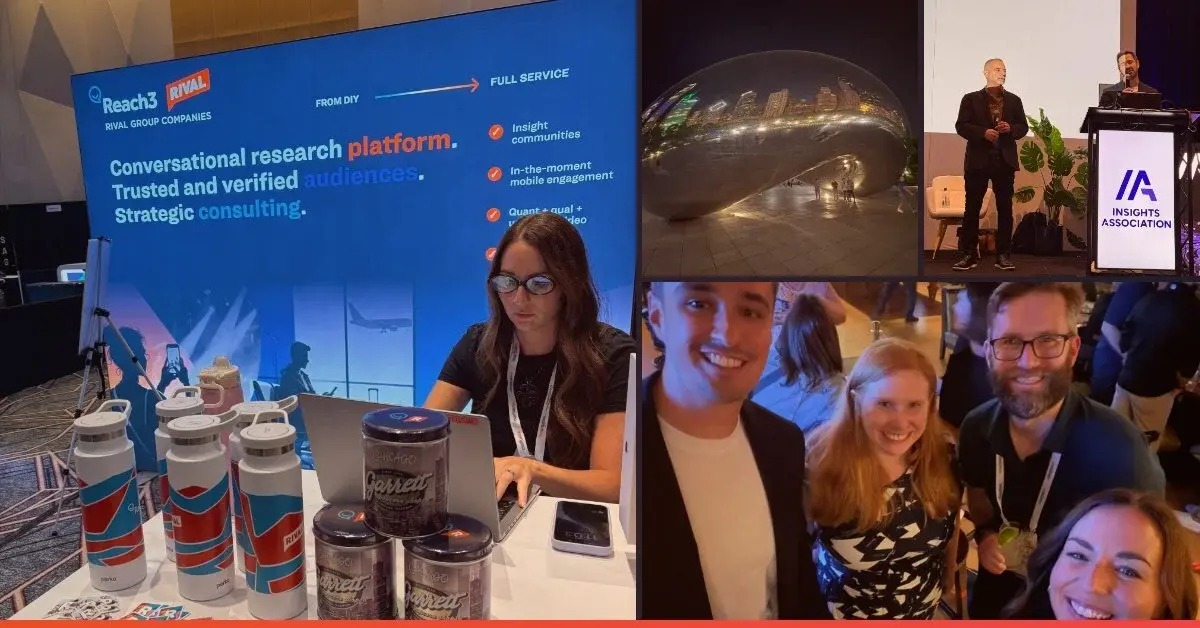
At this year's Insights Association Corporate Researcher's Conference (CRC), our Founding Partner Jonathan Dore joined Alex Maggi, Senior Manager of Consumer Insights and Strategy at GALLO, to share how Reach3 is helping the brand navigate rapidly shifting consumer preferences through AI-accelerated, mobile-first, conversational research.
The session echoed what we found in our own recent study, How Consumers Decide What to Drink: beverage choices are personal and emotional, shaped by taste, health, occasion and identity. Best understood through in-the-moment conversation, not static surveys. GALLO and Reach3 built that same principle into their approach, pairing quantitative signal with qualitative and video feedback delivered in formats stakeholders could actually engage with.
That focus on usefulness over speed was the through-line of the whole conference:
-
Decision readiness beats raw speed. Diane Lauridsen of T-Mobile put it plainly: when executives ask for insights faster, what they actually want is a decision-ready recommendation. Her go-to questions, what decision will this change, who needs to be in the room, what will the organization do differently, are worth borrowing.
-
AI raises the stakes on human judgment. AI is strong at spotting patterns in messy data, but weak on business context. One panel's example: a model priced an airline lounge for maximum revenue without accounting for its physical capacity, mathematically correct, operationally useless. It's a reminder that automation compresses the process, but people still supply the judgment.
-
Signals need a human to explain them. Intel's brand team pulls in social, search, and news data between tracker waves, not to replace it, but to know when a shift is worth a closer look. The signal shows something happened; the research explains why.
-
Modernizing a brand shouldn't erase its history. The Tropicana redesign came up as a cautionary tale: a packaging change disrupted a memory structure people relied on to recognize the brand. Know what the brand already means before deciding what to change.
-
Influence comes from focus, not volume. Rohit Bhargava's opening framework for "non-obvious thinking" made the case that curation, not more data, is what makes insights actually land.
The bigger picture: as AI absorbs more production work, the human role in insights becomes more visible, not less, which is exactly the thinking behind our work with GALLO, and our own beverage study.
For the full recap of CRC 2026, including takeaways on AI, human judgment and the future of insights read Rival's complete conference recap.