



AI in healthcare isn't coming someday. It's already here.
OpenAI has launched initiatives focused on clinical documentation and patient communication. Health systems are experimenting with AI-assisted diagnostics to catch diseases earlier and cut through administrative red tape. Your phone probably already has an app offering AI-powered symptom checks or personalized health guidance. Regulatory agencies and global health organizations are racing to keep up, issuing guidance on transparency, safety and data privacy as public debate heats up.
Innovation is moving fast. What's less clear is how consumers are actually feeling about all of it.
That's exactly what we set out to understand in 2026 Digital Health Trends, an ongoing research initiative from Reach3 Insights that tracks how attitudes toward digital health evolve as new technologies become more embedded in everyday life. Powered by Rival Technologies, the study uses our AI-accelerated, conversational research approach and a nationally representative sample from the Angus Reid panel. AI Smart Probe follow-ups helped us go beyond surface-level opinions to uncover the motivations and concerns actually shaping how people think about AI in healthcare — not just what people believe, but why they believe it, and how those beliefs shift over time.
What we found wasn't the tidy story you might expect.
Public opinion isn't consolidating. It's splitting.
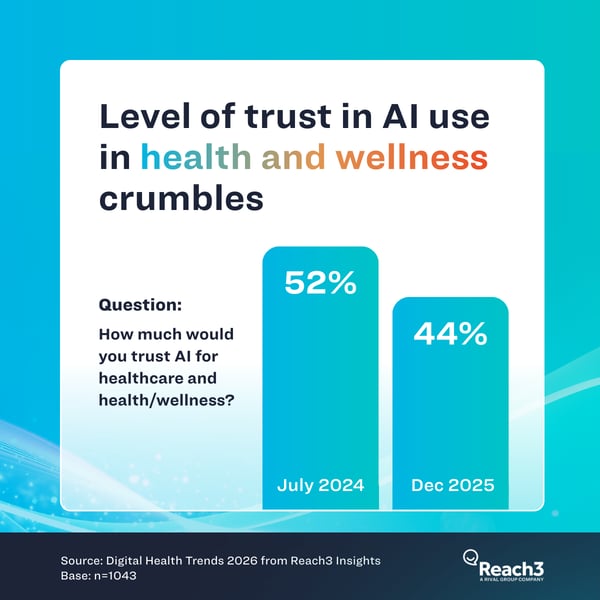
Here's the headline number: 44% of Americans say they trust AI in healthcare. That's down from 52% in our previous wave, with more than half now expressing negative sentiment toward its integration into health and wellness.
But that national average is where things get interesting — because it's hiding something dramatic underneath.
Among Americans who are currently using AI in health or wellness contexts, trust shoots up to 88%. Positive sentiment toward AI integration? 87%. Among non-users, trust drops to 38%, with just 41% reporting positive sentiment.
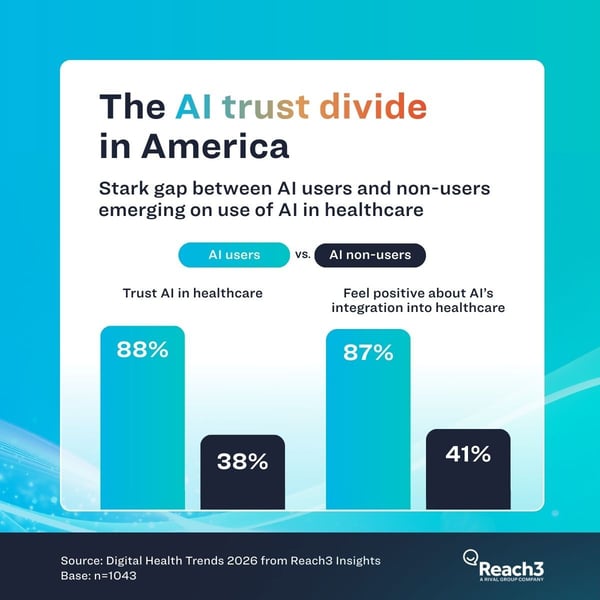
That's a 50-point gap — and it's not just a polling quirk. As Christine Nguyen, VP at Reach3 Insights, put it, this "trust gap" highlights the "meaningful role" that familiarity plays in shaping confidence. People who have actually used AI in healthcare have had a fundamentally different experience than people watching from the sidelines. Rather than a uniform backlash, we're looking at two parallel realities developing at once: one group engaging with the technology and building confidence through direct experience, another observing from a distance and weighing potential benefits against perceived risks.
Side note: Most Americans are still watching from the sidelines
Despite all the headlines and industry buzz, mainstream adoption is still pretty limited. Just 14% of Americans report currently using AI in health or wellness contexts. Another 29% say they're interested in trying it someday, while 38% aren't interested and 33% are still on the fence.
For the majority of Americans, AI in healthcare is still a developing concept rather than an established part of their lives.
Where people do engage with it, the use cases are telling. Consumers tend to gravitate toward applications that are fast and straightforward — translating confusing medical information, answering health questions, helping figure out whether symptoms are worth a doctor's visit. In these moments, AI is functioning as a helpful support tool, not a decision-maker. That framing matters.
For the majority of Americans, AI in healthcare is still a developing concept rather than an established part of their lives.
Even among engaged users, qualitative feedback reveals ongoing concern about accuracy, data privacy and the preservation of human-centered care. People are open to AI handling analysis and pattern recognition. They're a lot more hesitant about handing over critical health decisions.
What should healthcare and tech brands do next?
Here's the strategic reality: capability, regulation and consumer sentiment are all shifting simultaneously. Public perception of AI is shaped not just by personal experience, but by media coverage, policy debates and the latest high-profile product launches. Attitudes can move fast — sometimes well ahead of actual adoption.
The trust gap we're seeing today makes one thing clear: exposure changes everything. Early adopters are demonstrating strong confidence in AI, while a much larger segment remains cautious or undecided. Reaching both audiences — and understanding what will move them — requires continuous listening, not a one-time snapshot. A solution like Reach3's Voice of Market is built precisely for that kind of ongoing intelligence.
TLDR: Trust won't follow innovation automatically
Here's what our data ultimately point to: the future of AI in healthcare will be shaped as much by public perception as by technical progress. Trust builds when people experience practical value in their own lives. And right now, the people who've had that experience are enthusiastic. The much larger group watching from the sidelines? Still waiting.
That 50-point gap between users and non-users isn't just a research finding. It's a roadmap.
"AI innovation in healthcare is moving quickly, but consumer comfort develops at its own pace," says Matt Kleinschmit, CEO of Reach3 Insights. "Trust grows when organizations are transparent about how the technology works, clear about its role and intentional about educating people along the way. Bridging the gap between innovation and consumer confidence requires ongoing dialogue, not just technical advancement."
Two parallel realities are forming. One group is building confidence through experience, and the other is still on the sidelines, watching and waiting. The brands that stay close to both — and understand what it takes to close that 50-point gap — will be in a much stronger position for what comes next.
To explore the full findings from the 2026 Digital Health Trends study, you can learn more here.

.jpg?width=352&name=Digital%20Health%20Trends%202024%20Report%20from%20Reach3%20Insights%20(1).jpg)