


.jpg)
How Reach3 Insights and Warner Bros. Discovery are reinventing segmentation, semiotics and search for the AI-curated consumer.
Stop Using AI To Do The Same Thing Faster
Most of the AI conversation in research has been about efficiency: faster fielding, cheaper transcription, tidier summaries. That work matters — but it isn’t where the real prize lies. The bigger question is what AI lets us do that we simply could not do before, and how AI is changing consumers themselves.
At Quirks London 2026, our SVP of Research Patricia Chapin-Bayley took the stage with Sofia Gomez Garcia, who leads Content Sales Research at Warner Bros. Discovery, to share three innovations from a partnership built to push limits. The work is anchored by the WB A-List community — over 25,000 members across the US, UK, Canada, Japan, and now France and Germany — and a shared belief that AI should be used to invent methods, not just accelerate old ones.
“We’ve been working with Rival for some years now. We started with our A-List community — over 25,000 members across the US, UK, Canada, Japan, and now France and Germany. It’s been a great in-house tool and resource, and it became the bridge for us to expand our research work and start doing more custom work — which is how we then tapped into Reach3’s capabilities.”
— Sofia Gomez Garcia, Content Sales Research, Warner Bros. Discovery
1) Segment Moments, Not People
Persona-based segmentation freezes a viewer in time. In entertainment, the same person can move through five demand spaces in a week. With Sofia’s team, we built a dynamic segmentation that combines personas with demand spaces and lets a machine-learning algorithm ingest new data continuously. As clusters evolve, fresh demand spaces surface and segment drift gets flagged before it becomes a strategy problem.
As Sofia put it on stage, "we’re not segmenting people, we’re segmenting viewing occasions" — and the personas become more useful, not less.
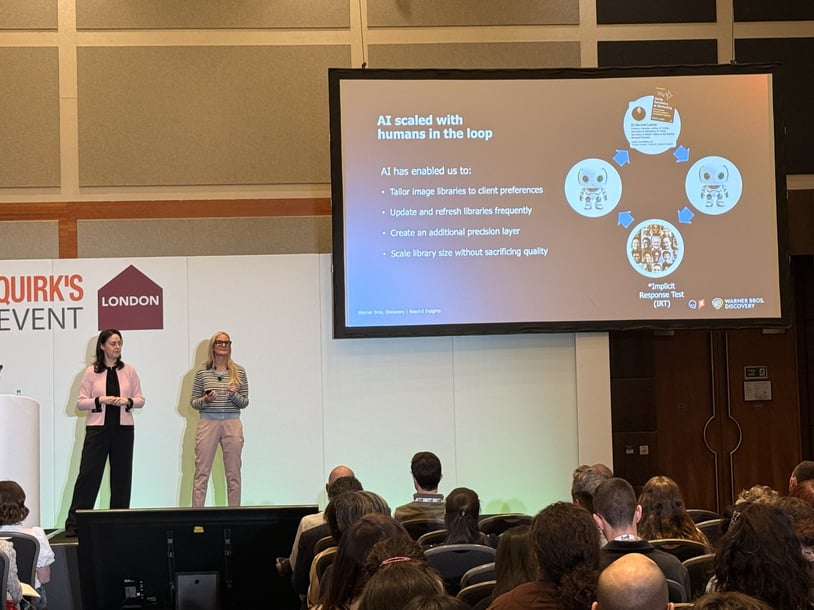
"AI scaled with humans in the loop" — Reach3’s methodology for keeping expert judgement at the centre.
2) Teach AI To See Content The Way A Semiotician Would
Semiotics is decades-old territory in market research, but the speed and scale of human-only encoding has always been a ceiling. We partnered with the UK-based semiotician Dr. Rachel Lawes to teach a large language model to read images the way she would, then closed the loop with an implicit response test among a large human sample to make sure the AI’s emotional encodings aligned with how people actually feel.
The output is a custom emotional elicitation tool that maps emotions to titles and to the demand spaces consumers want them in. It’s refreshable, expandable, and integrated into Reach3’s broader tech stack — credible because it was built with humans involved at every step.
3) AI Listening: Measure Your Visibility Inside The Black Box
SEO is being reshaped in real time. Consumers are asking AI assistants for recommendations the same way they used to ask Google — and those models know context, mood, and demand space. The recommendation you get on a Saturday night is hyper-personalized in ways no media plan could replicate.
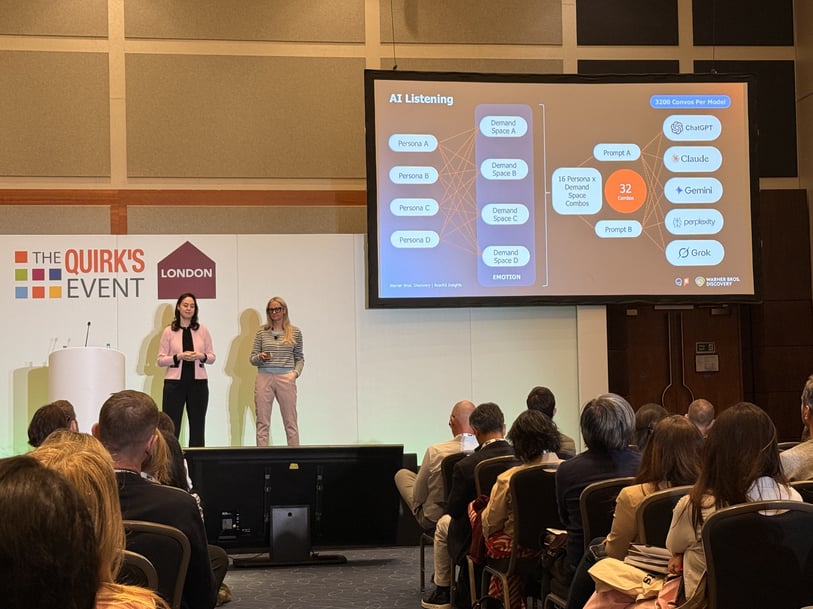
AI Listening recreates how real humans prompt AI, queried at scale across five large language models.
We built a framework called AI Listening that recreates, at scale, how real humans prompt AI in a content-discovery moment. Personas and demand spaces act as proxies, prompts are A/B-tested, and five large language models are queried repeatedly so the probabilistic nature of AI responses becomes a trend we can confidently report. The output is a measure of WB Discovery’s AI visibility, reputation, and recommendation rates — a baseline for what we’ve started calling AI optimization.
Welcome To The Anti-Social Media Age
Underneath all three workstreams is a bigger thesis. For two decades, social media has been about broadcasting to strangers. For younger generations, that posture is shifting. AI assistants are becoming private, insular curators of everyday life — what Patricia called the "anti-social media age" on stage. AI is becoming the ultimate influencer, and brands that don’t understand how it represents them inside that black box will lose visibility before they lose share.
Three Things Research Leaders Should Do This Quarter
- Stop treating AI as a workflow tool. Use it to invent methods that didn’t exist before — that’s where the disproportionate value is.
- Keep humans in the loop, intentionally. Frame every AI workflow with expert judgement and an implicit response check against real consumers.
- Start measuring your AI presence now. If LLMs aren’t recommending your brand, you need a baseline before you can optimize.
The work we shared at Quirks London is in flight; findings will follow in a part two later this year. Until then, the invitation is simple: experiment alongside us, and rival the status quo of how the industry has done research for the last forty years.
About Reach3 Insights — Reach3 Insights is a strategic market research consultancy that delivers better data, deeper truths and story-driven insights to fuel confident decisions for Fortune 1000 brands. As part of Rival Group — alongside Rival Technologies and Angus Reid — we combine technology, trusted audiences and consultancy expertise to rival the status quo in market research.