Pharma research asks a lot of the people who take part in it. A physician fits a long survey in between patients. A patient tries to remember a diagnosis from months ago. A launch team waits weeks for results, and the market keeps moving while the survey is in the field.
The pressure to understand and respond to changing patient and healthcare professional (HCP) needs is growing. Patients are taking a more active role in their care, while digital tools and AI are changing how people find health information and engage with treatment options. Pharma teams need timely, ongoing insights into these evolving attitudes, experiences, and behaviors to make informed decisions, from developing relevant communications to addressing barriers to treatment.
This playbook shows how researchers are applying mobile-first conversational methods to three common approaches: ATU (awareness, trial and usage) tracking and launch monitoring, patient journey research and communications testing.
“We need to know more. We need answers to be more precise. We need them faster, and we need them more frequently.”
Amr Eltokhy Senior Business Manager, Novartis
For each solution, you'll see the business challenge and why it matters today, how the methodology is applied, where traditional methods leave gaps, how the modern approach works, what your team gains and proof from client work.
The business challenge and why it matters today
How the methodology is applied
Where traditional methods leave gaps, and how the modern approach works
What your team gains
Proof from client work
Section 2
Why Traditional Research is Struggling to Keep Up
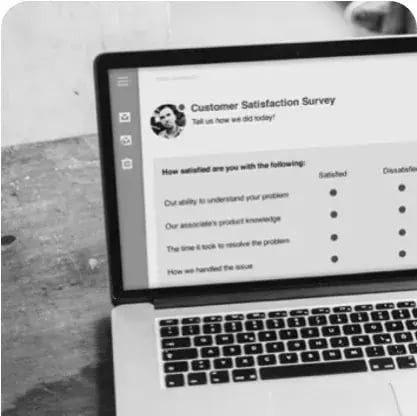
Pharma research has changed shape over the years. It began with landline phones and paper surveys. In the 2000s it moved to email surveys, which still follow one pattern: ask a question and wait for an answer. That approach produced a great deal of useful insights, but it was built for a different pace and a different participant. Our mobile-first conversational approach was designed to bring research into the modern age.
Early years
Landline phones and paper surveys
2000s
Email surveys: ask a question and wait for an answer
Now
Mobile-first conversational research
Five gaps come up again and again in pharma research.
01
Long and tiring.
A single survey wave can run 30 to 45 minutes. That is a lot to ask of a patient, care-giver or Healthcare Professional (HCP), and attention tends to fade toward the end, which puts data quality at risk. Cost and limited cadence limit how often teams can refresh insights.
02
Slow speed to insight.
Fieldwork can take a month or two, followed by weeks of waiting for the report. By then the business question may have changed.
03
Thin on the why.
Scores show what moved. They rarely show the reason why and the emotional context. Quantitative and qualitative work often run as separate studies, so the human context arrives late or not at all.
04
Backward looking.
Questions asked weeks after an appointment or a treatment decision depend on memory, and details and emotions fade.
05
Siloed.
Separate phases, reports and teams can leave an organization with several valid stories that never connect. A full study built in phases can take six months or longer.
Section 3
What changes with a modern approach
Side-by-side comparison
Traditional approachModern approach
ExperienceTraditionalA long survey, often on a desktop and sent by emailModernA mobile chat triggered by a text message notification
LengthTraditionalLong, episodic surveysModernShort mobile chats with the ability to seamlessly recontact
TimingTraditionalAsked after the factModernIn-the-moment feedback
FrequencyTraditionalInfrequentModernFrequent and ongoing
DepthTraditionalOften lighter on detailsModernAI probing asks follow-up questions in the same conversation
Quant and qualTraditionalSeparate, siloed phasesModernQual, Quant and Video in one seamless exercise
ResultsTraditionalFinal report delivered weeks after fieldModern24/7 access to real-time results
DeliverablesTraditionalA slide deck and data tablesModernDashboards, curated digital stories and a story-focused deck
Ability to recontactTraditionalEmail invitations that can lose participants between wavesModernSeamless ability to recontact via mobile text notification
The goal has not changed: sound evidence a team can defend. What changes is that results arrive sooner, closer to real life and with greater depth, richness and actionability.
Section 4
Modern Methodological Enhancements Applied Across Three Common Applications
What’s inside
Modern research philosophy.
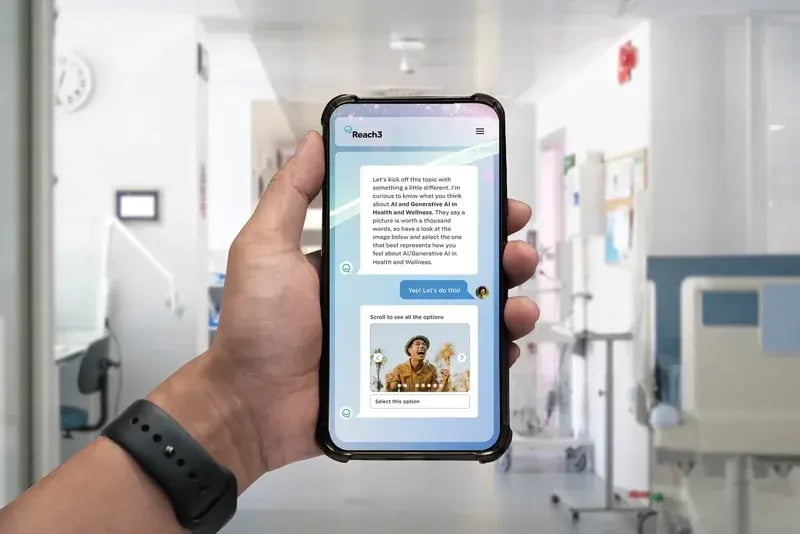
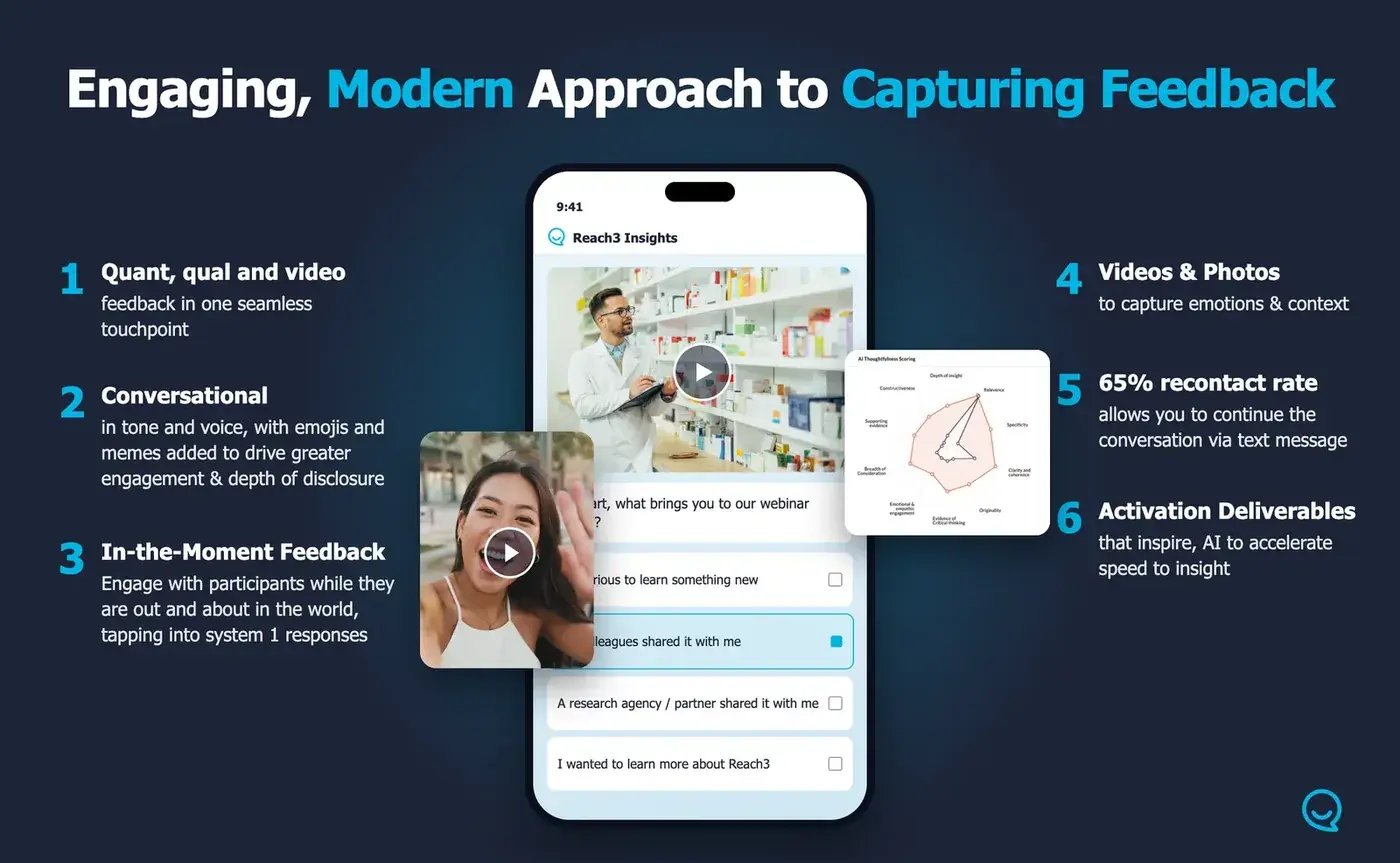
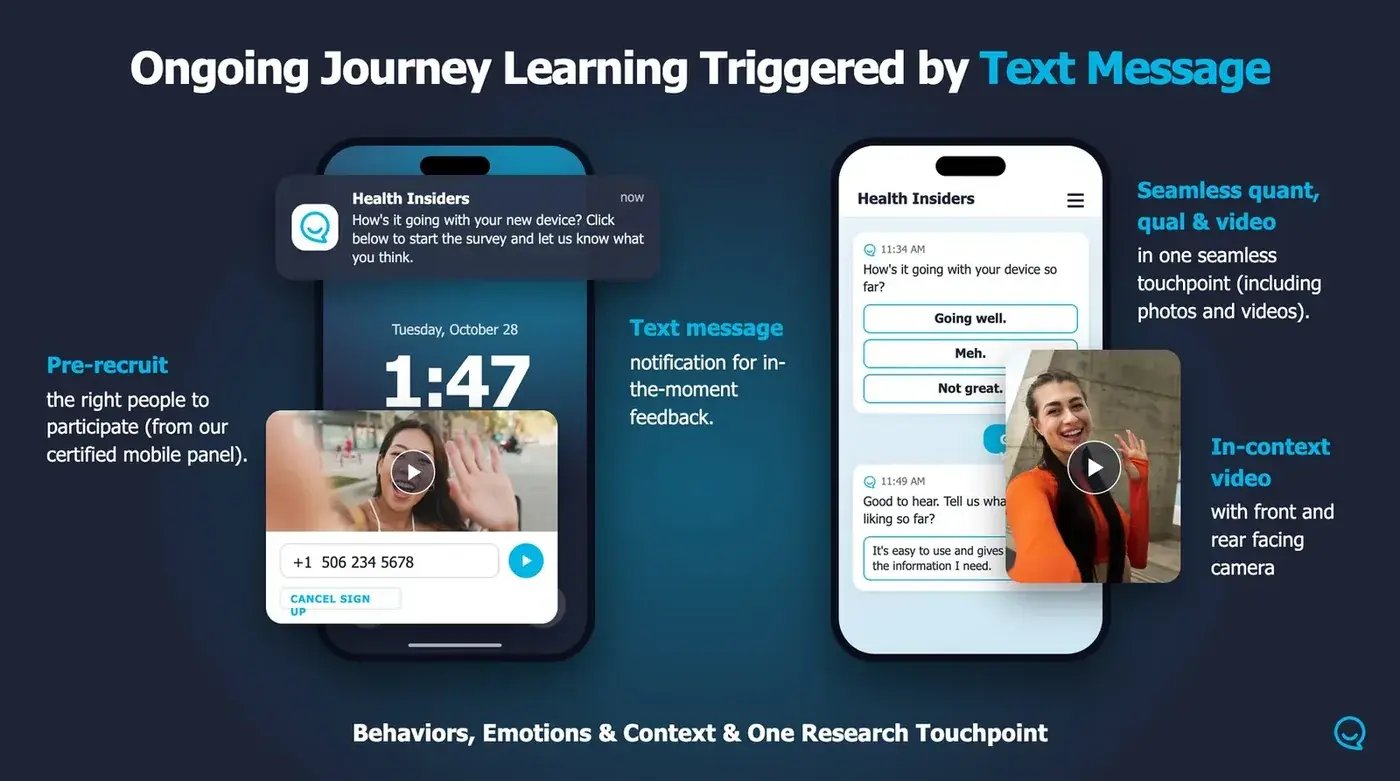
Triggered by text message, mobile chat-based exercises capture in-the-moment quant, qual, open text, photos and video, supported by AI-accelerated, researcher-led interpretation.
Solution 1
Modern ATU and launch monitoring with faster pulses and the context behind KPI movement.
Communications testing that identifies what performs, why, for whom and how to improve it.
Delivered by text message and email.
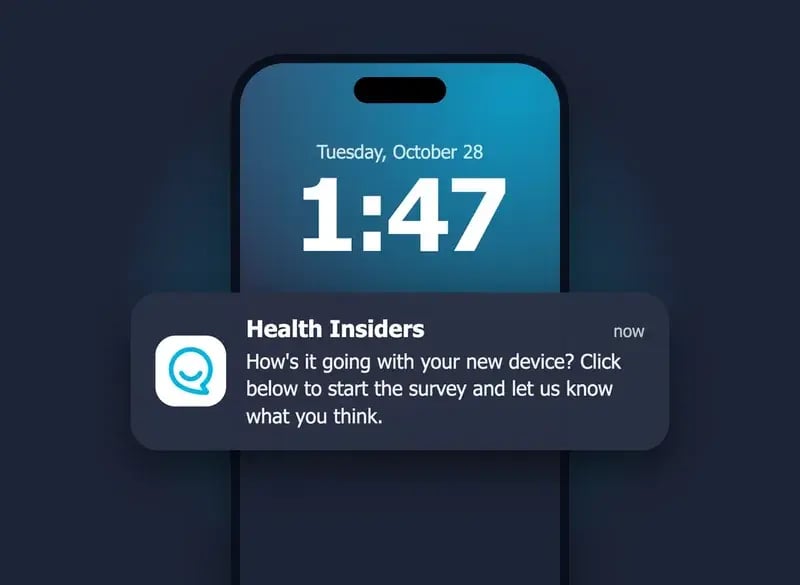
Participants opt in to receive mobile text message or email notifications, with no app download required.
Conversational research design.
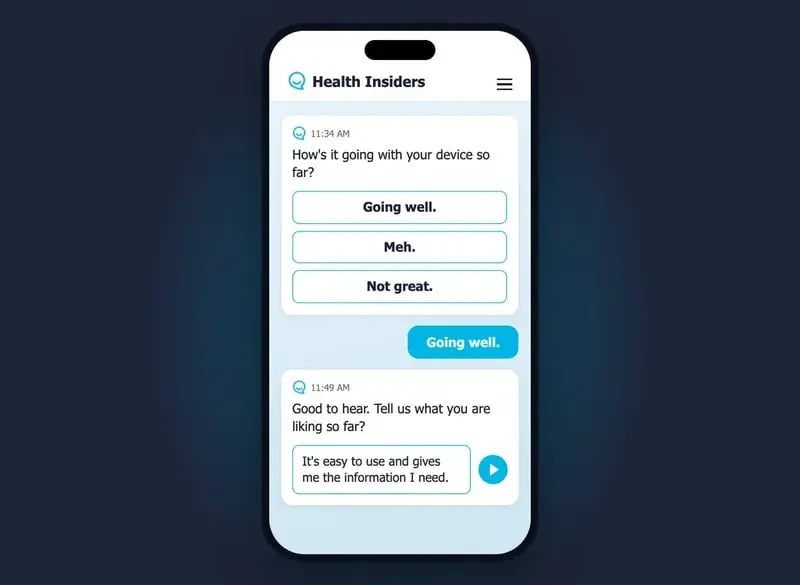
Chat-like conversational surveys are mobile-first, combine natural language, affirmations, and qualitative AI follow-up probes to reflect how people naturally communicate, ultimately encouraging more candid feedback and driving deeper disclosure.
Capturing in-the-moment feedback.
Engage people closer to an appointment, treatment decision, product experience or communication exposure, before details and emotions fade.
Quant, qual and video in one touchpoint.
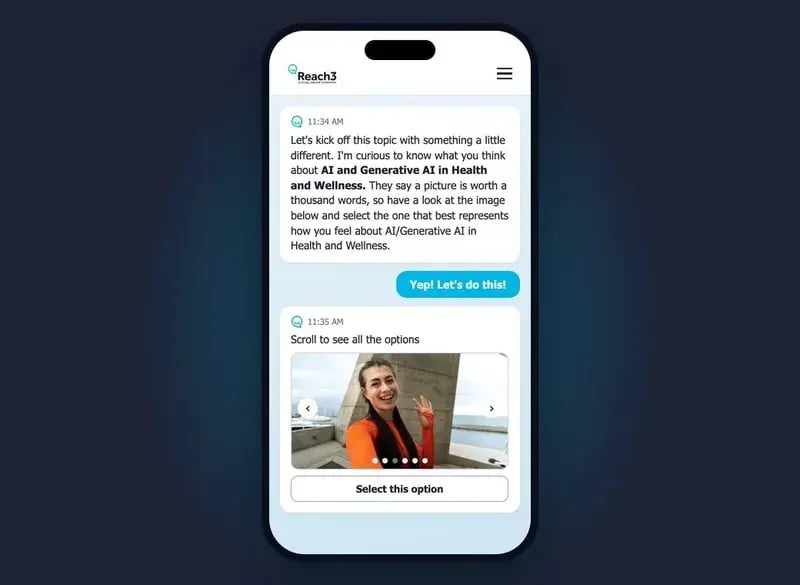
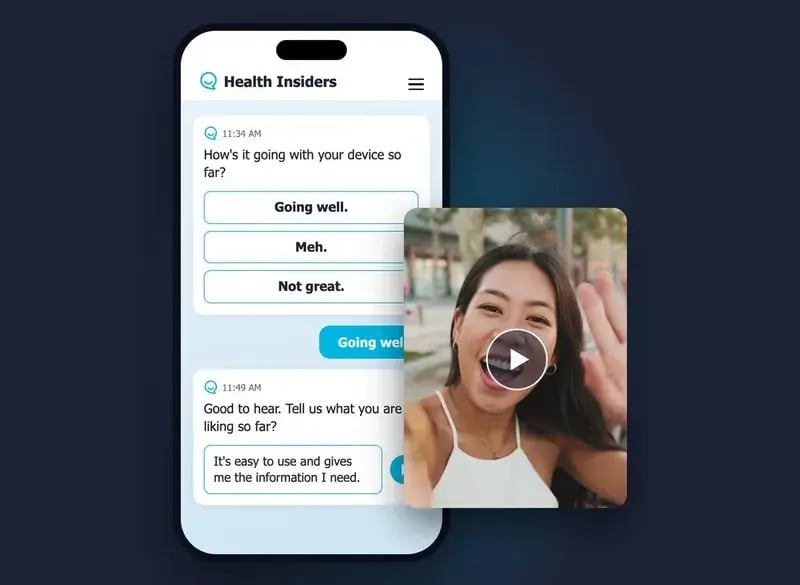
Capture structured, robust quantitative measures and qualitative inputs, at scale, including open-ended responses, photos, and front- and rear-facing camera video, keeping the metric and human context connected.
Deeper engagement. Research on research uncovered a 65% recontact rate, over 80% completion rate, and greater depth of responses when leveraging our mobile chat-based conversational research approach.
65%
recontact rate
>80%
of people who tapped the SMS completed the exercise in that sitting
7x
increase in words used in video responses vs. text open ends
Traditional email-based online surveyMobile chat-based conversational exercise
Built for pharma requirements.
The Rival platform used by Reach3 is SOC 2 Type 2 certified, and Rival Group is certified to ISO/IEC 27001:2022 and HIPAA/HITECH standards. Reach3 also has a dedicated adverse-event reporting team. Study-specific privacy, security, compliance and adverse-event requirements are addressed during scoping.
Section 5
AI-accelerated depth and analysis
Our modern conversational approach leverages AI tools built into the platform to support depth of responses and speed to insights. AI moderation and Smart Probing ask relevant follow-up questions based on what each participant said. On the back-end, our tool gives each response a thoughtfulness score and follows up with less thoughtful or incomplete answers. Researchers define the topic boundaries and number of follow-ups.
Live toplines show results as data is captured, while our platform's AI Summarizer identifies themes, sentiment and confidence scores with the supporting verbatims available for review. At Reach3 Insights, we take a human in the loop approach to AI tools. Researchers remain responsible for quality, interpretation and recommendations.
Solution 1
Modern ATU and launch monitoring
A launch happens once. After months of preparation, a team needs to know within weeks whether doctors and patients understand the product, how they compare it with competitors and whether the message is landing.
That is the job of an ATU (Awareness, Trial, Usage) study. Wave after wave, it measures how well HCPs and patients know a brand, whether they have tried it and whether they use or prescribe it, compared with competing treatments. Teams use the answers to decide where to adjust their marketing and sales strategy.
The pressure on that tracker is high. A launch may have an 18 to 24 month runway, or approval may arrive early while competitors and market expectations are shifting. Either way, the research has to move quickly without weakening the evidence behind positioning, messaging and early adoption decisions.
The challenge
Traditional ATUs show where the funnel moved but leave the why thin. Three gaps stand out.
Depth.
Rating grids show where interest drops. They rarely show the reasons.
Speed.
A long questionnaire, often 30 to 45 minutes, takes weeks to field and report, while a long survey experience drives fatigue and straight-lining.
Frequency.
Quarterly waves can surface a shift months after it began, with no follow-up in between.
The Reach3 solution
Keep the ATU foundation - awareness, trial, usage, current and future prescribing, consideration, perceptions, segmentation, competitive benchmarks and KPI trending - then add qualitative depth and rapid quant and qual pulses. Keep core KPIs consistent across waves to preserve comparability, while rotating additional diagnostic modules to give the team a faster way to investigate live questions between major waves.
Shorter, more frequent pulses.
A 30 to 45 minute quarterly wave could become eight shorter conversations of 15 to 20 minutes each year, with length and cadence tailored to the audience and business needs. Consistent core KPIs preserve comparability, while rotating questions explore new data, access changes or competitor moves within a month or two. Live toplines show early signals as responses arrive.
TraditionalConversational
30 to 45
15 to 20
4 a year
8 a year
Qual at scale and AI probing that explains the numbers.
AI Smart Probe can be enabled for open-ended questions to uncover deeper insights. It assesses each response for thoughtfulness and, where appropriate, asks a tailored follow-up based on what the participant shared—capturing the “why” and context behind responses without a separate qualitative study.
What your team gains
See what changed, why it changed, which audience is driving it and what the movement means for positioning, evidence, messaging and early-adoption planning.
What you receive
Consistent KPI tracking, live toplines, access to open-ended responses and participant video, AI-supported themes with underlying verbatims, and decision-focused reporting.
Best fit
Best fit when the launch date may move, the competitive narrative is changing, early-adoption assumptions need validation or the next tracker is too far away to support a live decision.
Case study
Understanding treatment choice
30physicians
The question: What is really driving a physician's treatment choice?
Reach3 presented 30 physicians with a realistic multiple sclerosis patient profile and asked them to select a treatment. AI-supported probing followed their responses to explore the priorities, tradeoffs and reasoning behind the decision, including whether changes to the patient profile would change their choice.
What the client gained. Deeper evidence on treatment priorities, tradeoffs, confidence and reservations at the speed and scale of a quantitative study - not a generic 'efficacy' or 'safety' answer that leaves the team wanting one more question.
Case study
Tracking a changing pre-launch market
8
rapid pulses
~500
patient records
100+
HCP selfie videos
Ahead of a product launch, a pharma company needed to track changing perceptions, evidence requirements and expectations around early adoption among dermatologists and allergists.
Rather than conducting one large study and waiting for the next wave, Reach3 used eight rapid quantitative and qualitative research pulses, incorporating approximately 500 patient records and more than 100 HCP selfie videos. The program gave the team an ongoing view of how perceptions were changing and how HCPs expected to approach early use.
Why this design mattered. The eight-pulse structure replaced a static snapshot with an ongoing market read, helping the team see how sentiment and intended early use were evolving while the launch plan was still being shaped.
Solution 2
Connected patient journey research
A patient journey map follows a person from the first symptom, through diagnosis and treatment and, for some, to the point where treatment stops. It shows who diagnoses, who prescribes, which treatments patients receive, how long they stay on each and whether the treatment is working. Teams build one, most often before a launch, to see where people get stuck, where support is missing and where help would matter most.
Behind every step is a person, and often a caregiver, trying to make sense of something frightening while managing daily life. Teams that understand those moments can act on them, by helping people recognize symptoms sooner, reach a diagnosis and stay on the care that is right for them.
Patient journeys are rarely linear. People experience uncertainty, revisit decisions and encounter setbacks, while patients, caregivers, HCPs and other stakeholders each see a different part of the experience.
“If you really want to get at what’s influencing how people think, feel, and behave at a point in time, you need to engage them at that moment.”
Matt Kleinschmit CEO and Founder, Reach3 Insights
The challenge
Retrospective research can blur the details of appointments and treatment decisions. Separate workstreams can also leave the organization with several valid stories that never connect. Three gaps appear most often.
In-the-moment learning.
Interviews held weeks after an appointment depend on memory. Details, emotions and everyday friction fade.
Siloed methods.
A qualitative phase, then a quantitative phase, then a merged report can leave an organization with several valid stories that never connect.
Speed and investment.
Each phase adds time and cost. A full study built this way can take up to six months.
The Reach3 solution
Combine interviews for individual stories, conversational surveys for scale, mobile diaries or ethnography for experiences as they happen, and quantitative analysis to size and prioritize what emerges. Build the work in stages so each round of learning sharpens the next and the perspectives remain connected. Two capabilities make this practical.
Learning in the moment.
Through participant-initiated diaries or agreed check-ins via mobile text notifications, participants can share experiences at key points along the journey, such as after an appointment or on a difficult day, while details are fresh. They can add photos and video when appropriate, and the same people can be invited back over time to show how their experience changes.
One conversation instead of separate phases.
Conversational surveys combine measurement with qualitative depth, and AI probing asks follow-up questions as people answer. Qualitative and quantitative work can run together instead of in sequence, which can shorten the timeline and keep every perspective connected.
Did you know?
A mobile-first approach increases depth of disclosure: people are more likely to disclose sensitive information when responding via mobile.
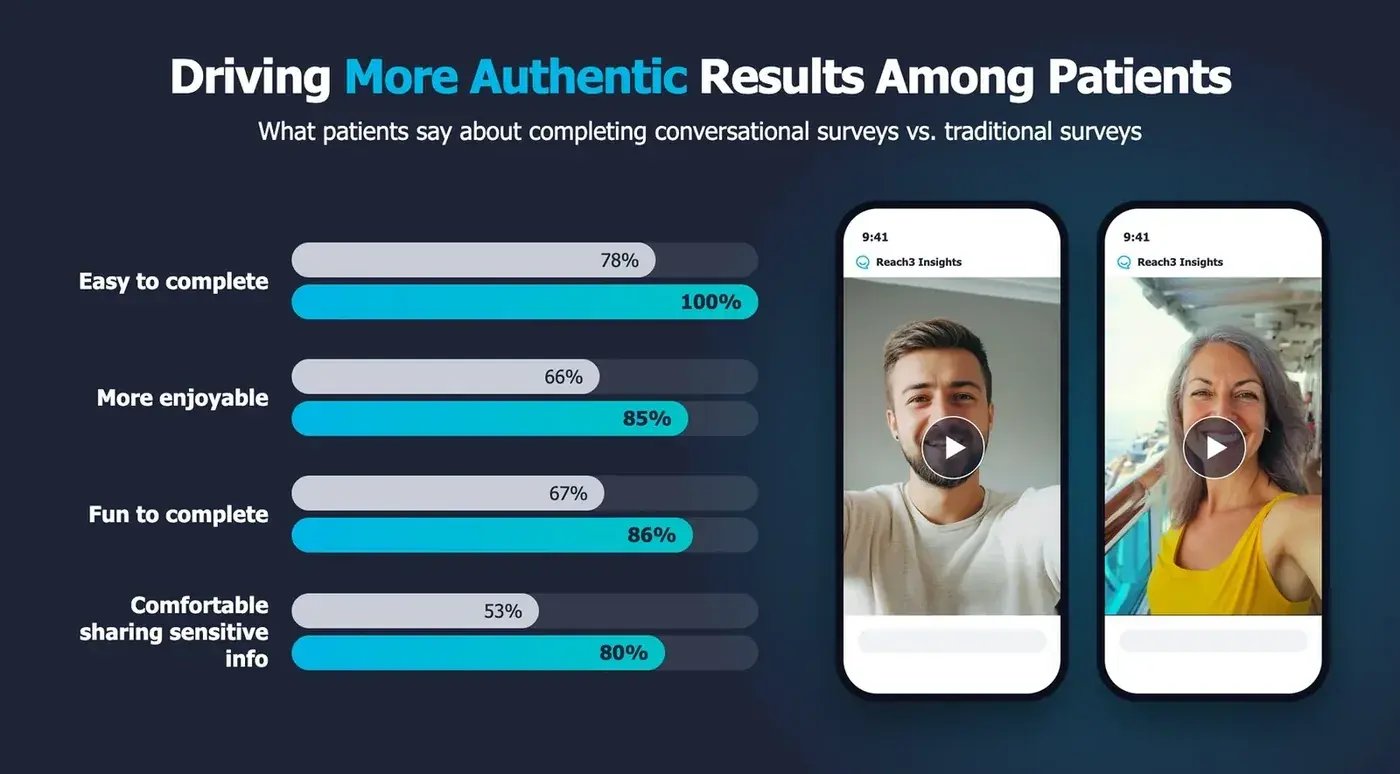
The phone is a personal device, and the exchange feels like a chat, so participants may feel more comfortable sharing sensitive details. In Reach3 research comparing mobile conversational and email surveys among patients, 80% of participants in the conversational format said they were comfortable sharing sensitive information, compared with 53% in the traditional format.
Comfortable sharing sensitive information
Conversational
80%
Traditional
53%
What your team gains
Move beyond a descriptive map to shared priorities for education, navigation, adherence and patient-support design.
What you receive
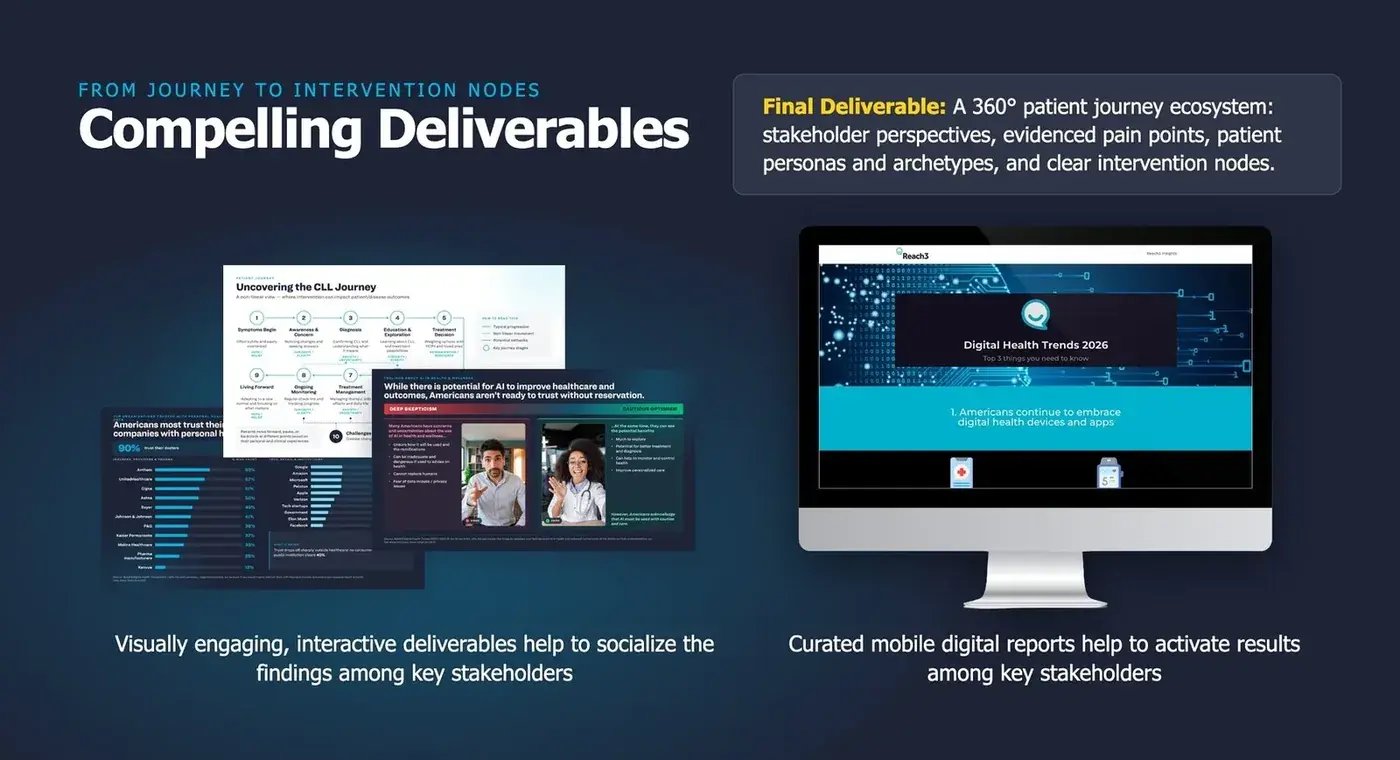
A 360-degree journey ecosystem with stakeholder perspectives, evidenced pain points, personas or archetypes and clear intervention nodes, supported by visual reporting, participant video and curated digital stories.
Optional extension
The patient journey is evolving, with AI showing up in various stages of the journey. When AI search influences discovery, Reach3's AI Listening can monitor how a brand or product appears across five major language models and identify opportunities to improve how it shows up in AI search.
Best fit
Best fit when the therapy area is new, the path is non-linear, recall risk is high, stakeholders hold different pieces of the experience or a support program needs clear design priorities.
Case study
Connecting the CLL patient journey
A pharma company preparing to enter the chronic lymphocytic leukemia (CLL) market needed to understand the end-to-end patient journey to inform a patient support program.
Reach3 brought together qualitative and quantitative research with patients, caregivers and HCPs, using conversational and projective techniques to explore both the clinical experience and the emotions surrounding it. The research showed a journey that was not always linear, with patients experiencing uncertainty, revisiting decisions and encountering setbacks along the way.
The work identified points where additional support could make a difference and helped define priorities for education, navigation and adherence support.
Business impact. The work moved beyond a linear journey diagram to identify high-impact support points and define priorities for patient education, navigation and adherence. It also gave commercial and medical teams one shared view of the patient.
Solution 3
Communications testing in the real world
Communications testing checks the messages pharma teams put in front of HCPs and patients: the talking points sales representatives and medical teams carry into a clinic, brochures and education material, and advertising aimed directly at patients. These materials shape how a physician understands a treatment and how a patient decides whether to ask about it. Teams test them before launch spend is committed, because a message that confuses or fails to persuade is harder to correct once it is in the field.
Messages receive more attention in a research session than they do in real life. An HCP may see one between patients; a patient or caregiver may encounter it while managing other demands.
The challenge
Traditional testing tends to leave three gaps.
Limited depth behind the scores.
A winner versus loser ranking may identify the strongest option without showing what created credibility, confusion or motivation, or how reactions differ by specialty or audience.
A repetitive, artificial experience.
Rating after rating does not look like real life, and participants can tire of it.
Missed in-the-moment reactions.
Questions asked afterward can smooth over the confusion, hesitation or enthusiasm that appeared when the message first landed.
The Reach3 solution
Measure clarity, comprehension, relevance, credibility, differentiation, memorability and intent to act. Then add two capabilities that explain the scores.
AI probing that captures the why.
Follow-up questions asked in the moment help participants explain what worked and what did not, in their own words. For patient-facing creative, short video reactions can also show how an ad landed.
Facial coding and tone analysis that show the reaction.
These tools help reveal emotion, enthusiasm, hesitation and conviction as a message lands, next to what participants say.
The evidence comes together in one study, with benchmarks and advanced analytics such as MaxDiff (participants pick the most and least important option from a set), driver analysis (which factors push people to act) and TURF (which mix of options reaches the most people).
What your team gains
Know what performs, why it works, who it works for and how to strengthen message selection, detailing or DTC creative before launch spend is committed.
What you receive
Immediate access to KPIs, open-ended feedback and participant video, followed by competitive context, prioritized optimization guidance, curated analysis and optional video showreels.
Best fit
Best fit when you need to select among messages or creatives, understand specialty-level differences, diagnose weak performance or optimize an execution before launch.
Case study
Tracking biosimilar messaging performance
A biosimilars manufacturer needed to understand which messages influenced prescribing and how their impact varied across gastroenterology, rheumatology and dermatology.
Reach3 combined quantitative messaging research with facial coding and tone analysis to measure recall, relevance and emotional response. The research identified higher- and lower-performing messages by therapy area, surfaced specialty-specific opportunities and informed future detailing and messaging strategy.
Business impact. The client could tailor future detailing and messaging by specialty instead of assuming that one message would perform the same way across gastroenterology, rheumatology and dermatology.
Case study
Optimizing DTC video creative in eczema
The question. Which execution is most likely to stand out, communicate treatment benefits and motivate patients to speak with their doctor?
The approach. Reach3 benchmarked three client ads against competitive category creatives using monadic testing, AI Smart Probe, patient video reactions and driver analysis.
The result. The study identified the strongest execution for attention, memorability and doctor-discussion intent. It also revealed the key drivers of action and specific opportunities to strengthen benefit recall, emphasize long-term skin improvement and improve differentiation.
Business impact. The client received specific guidance to improve the creative, rather than only a ranking of winners and losers.
Section 9
What the three solutions have in common
The same pattern runs through all three. Traditional methods tell teams what happened, later than they would like and without the reasons why. A modern, mobile-first conversational approach asks people in the moment, in a familiar way and keeps metrics and motivations together.
Solution
ATU and launch monitoring
The pain
Shifts show up late and the why is thin
The modern “Reach3” approach
Frequent pulses, live toplines and AI probing in one tracker
Solution
Patient journey research
The pain
Memory blurs the details and the phases stay siloed
The modern “Reach3” approach
In-the-moment insights and video in one connected study
Solution
Communications testing
The pain
Scores arrive without reasons, in an artificial setting
The modern “Reach3” approach
AI probing and reaction analysis alongside the metrics
The standards stay the same: comparable measures, researcher-led interpretation and insights a team can defend. What improves is how soon the team can learn, the depth of insight, and how well it understands the people behind the numbers.
Section 10
Bring Reach3 in before the methodology is locked
A conversational, mixed-method or continuous design is worth considering when the business question is clear but the research plan is still flexible.
1
Will we want to understand the ‘why’?
Look for answers such as efficacy, safety or convenience that may not explain the reasoning or tradeoffs.
2
Could the market change before our next wave?
A shorter pulse may answer the live question while the decision is still open.
3
What will be difficult to remember later?
Appointments, treatment decisions and first product experiences may be better captured closer to the moment.
4
Whose perspective is missing?
Identify where patient, caregiver, HCP and access views need to be studied together.
If two or more conditions apply, involve Reach3 early enough to align the audience, cadence, in-the-moment triggers, AI guardrails, analytics and deliverables to the decision.
Section 11
Why health and pharma teams work with Reach3
Reach3 is a strategic insights consultancy that combines health and pharma research expertise with conversational research methods, powered by the Rival Technologies platform. It supports teams across the product lifecycle, from pre-launch landscape and patient journey work through ATU, communications testing, patient support research and ongoing communities.
The team can connect qualitative and quantitative methods, launch rapid pulses, run longitudinal mobile research and apply advanced analytics according to the business question. Clients can view core KPIs and unstructured feedback as data arrives, then activate the findings through visual presentations, video showreels and curated digital stories for non-research stakeholders.
Try our chat!
Scan the QR code to take a demo chat and learn more about our conversational approaches.
The next decision is already on your team's calendar.
Planning a pharma research initiative? Bring us the decision, the audiences and the timing. We will help you choose the research design that gets you answers while there is still time to act.