



Agile insight platforms have been around for years, but what companies expect from them has changed.
During a recent Reach3 Insights Conversational Masterclass, CEO Matt Kleinschmit and EVP and Founding Partner Leigh Admirand discussed why more organizations are investing in always-on research programs, what those programs should deliver and how AI is influencing both the speed of business and the way research teams work.
 The shift started before AI became part of every business conversation. Leigh said, "There's always been a need for speed in research, but over the past few years, and even during COVID, there seems to be an accelerating pace of market change in consumer preferences."That pace makes it harder to rely on project-by-project research alone. Research teams still need foundational studies, but they also have tactical questions that can't wait weeks for a final report.
As Leigh explained, "Today, there's just not enough time to execute older or siloed ad hoc studies and sometimes they're out of date before the final report gets done."
Why organizations are taking another look at agile insight programs
Traditional agile insight platforms gave research teams a way to answer business questions quickly across multiple stakeholder groups. Today, expectations have grown well beyond that original purpose.
"Many brands are building their own LLMs," Matt said, creating demand for "on-demand decision intelligence platforms that can continuously inject fresh human ground truth data into these models."
Internal stakeholders are also becoming accustomed to asking AI for quick answers, putting more pressure on research teams to deliver timely evidence without compromising quality.
Why some agile research programs fall short
Not every agile research program has kept pace with how companies want to work today. During the masterclass, Leigh noted that many are still "simply packages of standard ad hoc studies that are sold together."
Common issues can include:
- Still leveraging old email-based online surveys as the primary data collection tool.
- Not offering seamless photos and videos, and often not including qualitative research.
- Poor sample quality, including bad data, bots and lots of straight lining.
Many companies are also looking for platforms that are AI ready, with capabilities such as AI moderation and the ability to feed research into internal LLMs.
Start with the operating model
Successful agile research programs start with implementation rather than technology. Before launching a platform, companies should define how it will be used, what it will support and what falls outside the program.
Planning typically includes:
- The types of research the platform will support.
- The audiences and sample groups it will engage.
- The operating model.
- Reporting standards and success measures.
As Leigh put it, every organization should answer one question early:
"What does agile mean to your organization? There are a lot of different ways to define agile."
Bringing qual, quant and video together for agile research
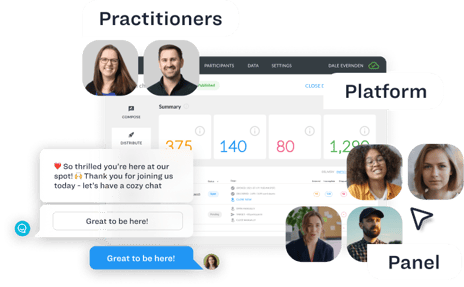
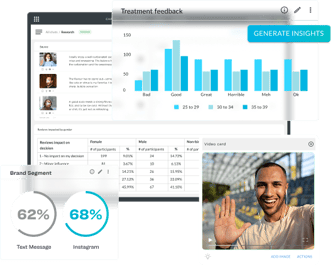
Bringing qualitative, quantitative and video research together lets teams choose the right method for the question they're trying to answer without moving between different platforms or suppliers. Reach3's conversational approach combines those methods on a single platform, making it easier to move between concept testing, in-depth exploration, shopper research and ongoing tracking.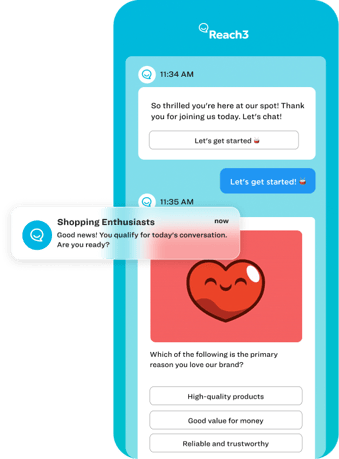
Programs can support concept and message testing, shopper missions, online diaries, in-depth interviews and ongoing tracking within the same operating model.
The conversational approach uses mobile text messaging notifications to reach participants where they're already communicating. As Leigh explained, "It's really because SMS gets opened in the moment. Everyone always has their phones next to them."
That conversational format also changes the participant experience. As Matt noted, "They don't really feel like they're taking a test like they do with a traditional online survey. Instead they just feel like they're sort of communicating with a friend."
AI also supports the platform through features such as Smart Probe, which generates follow-up questions based on participants' responses. AI summaries help researchers review video and open-ended feedback more quickly.
What this looks like in practice
The examples Matt and Leigh shared during the masterclass show that always-on agile research can support very different business needs.
Amazon Music uses an ongoing global program to study younger audiences and new product features. A major U.S. financial institution supports multiple business units through a dedicated agile program, while Hershey tracks shopper behavior across key seasonal moments. CareFirst BlueCross BlueShield combines consumer and B2B research to support healthcare decisions.
In each case, research teams have continuous access to customer feedback instead of launching a new project every time a business question comes up.
A Modern Research Model
Every agile research program starts with the same questions:
-
What business decisions should it support?
-
Which studies belong in the program?
-
How will different teams use it?
If you're exploring an always-on approach, Reach3 can help you design a program that fits your research needs and business goals.
Learn more by watching the full Masterclass Webinar on the Agile Insight Platform, or learn more about the fundamentals of conversational research with 9 key principles designed to uncover richer, more authentic consumer insights.